Tad Investigates the Magical Break-In at the Cottage
One Thousand and One NightsTad Investigates the Magical Break-In at the Cottage is the opening strand of Tad and Claire’s case: an intrusion leaves Tad’s carefully ordered home and prized possessions intact but disturbs his kitchen cupboard. By treating that small disorder as evidence rather than overlooking it, the investigation connects the break-in to a broader mystery involving magical gold, a dishonest merchant, and the materials he seeks. The case also gives concrete form to Tad and Claire’s wager over whether romance or science is the better way to solve a problem.
The Intrusion and Its First Clues
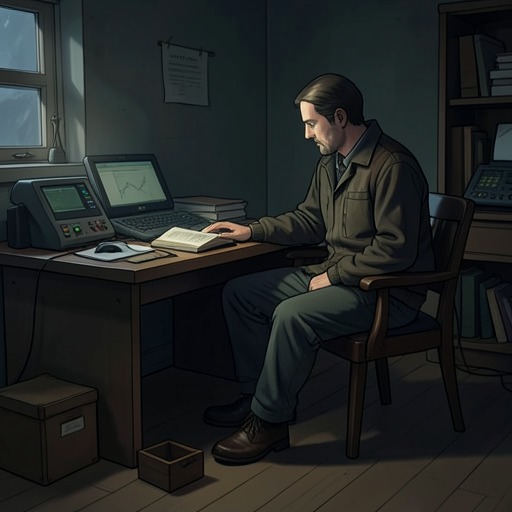
Tad’s alarm is sharpened by the thought that someone has entered his cottage. He searches it room by room, first checking the possessions a burglar might be expected to take. The money he keeps for wooing true love remains in his sock drawer; his collection of rare love poems is still concealed beneath his underwear. His wardrobe, too, is untouched: its vests with shiny buttons, polished boots, fashionable coat and cap, and pressed trousers have all been passed over. To Tad, the untouched finery makes the intruder’s choices stranger, not less significant.
The kitchen supplies the one clear disturbance. Several things in a cupboard have been shifted, as if someone searched for a particular ingredient and failed to find it. Tad notices that the front-door lock shows no scratches or dents, so he reasons that it was opened by magic rather than forced. Nothing has been stolen, he insists, because he knows the contents of his house by heart; what matters is the deliberate movement of objects in the cupboard. His attention to order turns an otherwise invisible absence into the case’s first usable clue.
Claire initially doubts that a break-in occurred at all. She surveys the sitting room and points to Tad’s expensive rug as evidence that the house contains little worth taking, while Tad’s account of the cupboard keeps the question open. Her skepticism and his confidence establish their competing approaches early: he trusts close personal familiarity with the scene, while she tests his interpretation and asks whether he brought anything home from the library. The possibility that an object of Tad’s own could have attracted the intruder shifts the investigation from a conventional burglary toward a search for a particular magical material.
A Case Shared with the Wager
The cottage investigation unfolds alongside Tad and Claire’s challenge to decide whether science or romance is the stronger method on this case. Claire characterizes Tad’s reliance on poetry and romantic intuition as scientifically unsound; Tad accepts the challenge, and they still have to settle who will judge the result. The wager makes their disagreement more than a difference in temperament: each new clue can test the method that produced it.
Claire’s examination of a gold necklace offers a clear example of her process. She unwraps the pendant, moves a square metal-like object over it, then uses a vial of liquid with a yellow stopper, putting a single drop on the gold. Tad sees only a slight fizz, but Claire treats that response as confirmation of her suspicions. The episode establishes a pattern that bears on the cottage clue: physical traces and controlled tests can expose distinctions that appearances conceal. It does not, by itself, explain the disturbance in Tad’s cupboard, but it helps define the investigative contrast through which the larger case is pursued.
The inquiry also turns on the necklace’s circulation. Claire asks why someone would exchange a finely crafted object of genuine gold for roughly the same amount in gold coin. She considers alternatives: the merchant might have stolen it and wanted to dispose of it, or might have bought it cheaply while knowing it was stolen. If the merchandise were stolen, openly displaying it beside legitimate goods would expose the seller; Claire therefore reasons that such a merchant would need to sell to foreigners. Tad confirms that the necklace was hidden until the merchant had looked him over. Claire concludes that the merchant knowingly acquired dishonest goods, while Tad’s theory is that a thief watched him buy the necklace and then followed him to pick his pocket. The distinction between fraudulent gold and stolen property remains important to the investigation: one concerns what the object is, the other how it came to be sold.
Following the Magical Trail
Tad pursues the case through the Magic globe as well as by inspecting physical clues. Seeking to learn what Zaen had been doing, he magicks himself to a place shown in the globe, expecting to find the scene he had seen there. Instead, he arrives at night on the outskirts of Shub-Haramb. The globe had shown what Zaen had done earlier, not what was happening at Tad’s arrival, and time in Shub-Haramb does not match the time in Tad’s home realm. Hungry after missing lunch, Tad is about to inspect the stables when he hears an elfin voice among the trees. He creeps toward the treeline and sees a small hooded figure dancing on a log, boasting that he has Della and that her father cannot calculate. The discovery links a concealed magical scheme to the wider case, though this scene takes Tad beyond the cottage itself.
The Magic globe later supplies a more specific image of Zaen and Della’s father entering a hidden treasure chamber. Della’s father lights two candles, takes one toward a pile of straw, and says the password Open sesame. A rug lifts to reveal stairs, then settles back into place after both men descend. Below it, the candlelight shines against heaps of treasure. Zaen observes that the thief has not taken very much. The scene makes a small quantity of missing material significant against the scale of the hidden hoard, echoing the cottage’s own puzzle: the intruder’s selective interest matters more than the value of whatever has been left behind.
The stakes of the larger case become clearer when Della’s father explains that the jinn’s claim on Della is already affecting her memory. The jinn holds her mother’s necklace and her father’s ring as proof; when she turns twenty-one, he will claim her, and the inheritance she is to receive will pass to him. Della’s father recalls that this demand followed his third wish to put the jinn back into the lamp, and that the creature had refused his attempt to bargain over the firstborn-child demand. His account connects the objects to a claim with a deadline, transforming apparently separate valuables into evidence and instruments of a magical contract.
Seeds, Identity, and the Break-In’s Meaning
Tad’s research in the library provides a possible folkloric parallel. He learns that jinn or genies are half fairy and half something else, mischievous and unpredictable, and capable of being helpful or harmful according to their nature. A story about a miller’s daughter describes a creature able to spin straw into gold; Tad suspects that it may be the same jinn who tricked Della’s father, although that version contains no lamp. The partial match offers a lead rather than a complete solution, preserving a gap between the familiar tale and the particular facts of the case.
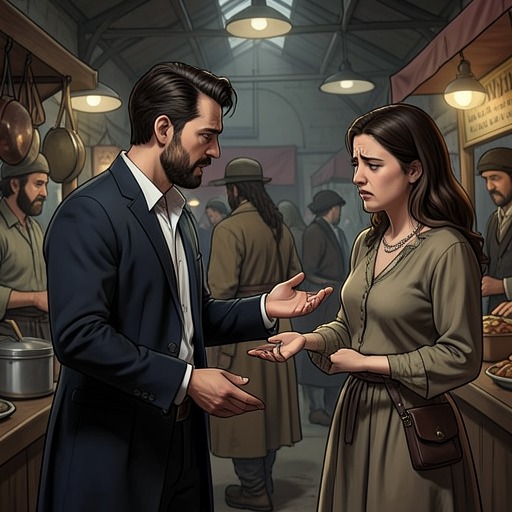
At a crowded scene, Tad and Claire hear a merchant offer gold jewelry in exchange for a correct guess of his name. The demand recalls the miller’s-daughter story, but Tad cannot remember the unusual name beginning with R. The merchant’s offer makes identification itself the test: the crowd can win an item by naming him, while an incorrect guess costs them nothing. Later, Tante Iezavel recognizes the spinning wheel Tad bought among Claire’s projects as unique. The merchant calls himself Rumpelstiltskin, demands his wheel back, and stamps his foot. Tante Iezavel’s sister, Paribanou, identifies him as their brother and rebukes him for passing off what he spins as gold, since humans cannot distinguish it from the genuine metal. That revelation connects the case’s apparent gold and the missing, sought-after materials to a known magical trickster and his wheel.
The cottage clue returns at the ending, when Tad suddenly sees what he had missed. He goes to his garden shed and rummages for items he had cast aside weeks earlier, realizing that things were not as they first appeared. He then hurries to Claire’s door, announces that the intruder was magical and that he has worked out what they wanted, and opens his hand. Green and gold lumps glow in his palm. Claire calls them beans; Tad corrects her: they are seeds. The distinction gives the break-in its sharpest reversal. The cupboard’s disorder was not random, and the apparent beans are not merely kitchen clutter: the sought-after seeds connect the intrusion to the magical investigation’s material clues. The evidence here ends with Tad naming what he has found, not with an account of how the seeds were used or of the break-in’s final resolution.
As an investigative episode, the case turns on the difference between what looks valuable and what is actually wanted. Tad’s immaculate house, the unforced lock, the slightly disturbed cupboard, the merchant’s disguised gold, and the seeds in his palm all invite a second reading. Its method is similarly double: careful attention identifies small irregularities, while comparison and testing correct an investigator’s first impression. The cottage’s quiet disturbance thus serves both as a concrete clue and as the point where Tad and Claire’s rival approaches begin to converge on the same question: what, precisely, was the intruder searching for?